Posts

Early Warrants

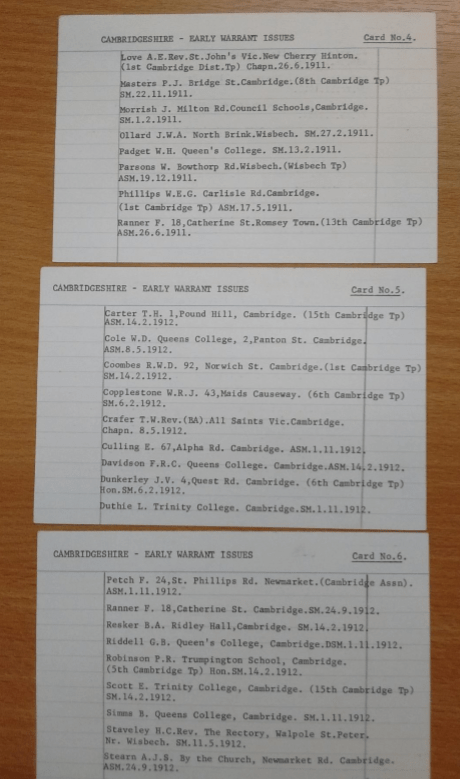
Following the previous post I have put together the start of a number of small tales drawn from the list of Early Warrants held by Gilwell archives.

The stories are informing the larger articles but will be presented here as stand alone pieces as I trace them to a fair certainty.

Some lives are likely to remain obscure – ‘H Halls’ abound and rarely come with labels of ‘Scout in Cambridge’.

See Tales from People/ Individuals/ Early Warrants/ Tales from Early Warrants

JWR

Also ran

Following up the later histories of those on Gillwell’s list of early Cambridge Warrants (pre WW1) has lead to some new candidates of for the Rolls of Honour. These have been added to the appropriate page under Local History/ WW1 WW2/ Rolls of Honour.

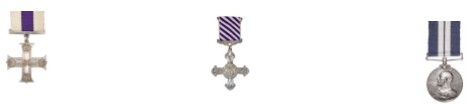
Others were listed as gaining Gallantry Medals, and these have fed into the page considering the frequency of holders joining Scouting and coming from Scouting – to no clear cut conclusions. See – Structure/ District/ Early Establishment Support.

It would be odd if some of the Cambridge students, at least, had not moved towards the top of their professions, Professors, Bishops and the like, and these have fed into unpublished lists which may inform later pages.

And a small subset of Prisoners of War is emerging. Some died in captivity. I had written ‘none were rewarded with medals for Gallantry’ but one has emerged who was – at least for escaping and getting home. These inevitable but unfortunate individuals tend to get lost in the records – these are rarely places from which stories or histories emerge.

But at least one (now two) Cambridge Scouters did participate in action most worthy of note from prison. The story of the Great Wars ‘Great Escape’ can be found under People/ Individuals/ Early Warrants/ Tales from the Early Warrants.

JWR

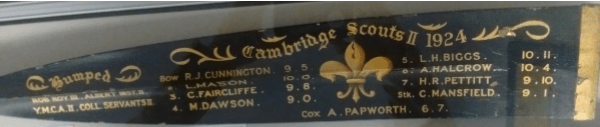
Cambridge Scouts Boat Club

Active from 1923 to 1979 this boat club, apparently unique within Scouting, was very successful in terms of numbers involved and listed some notable achievements along the way.

The first workings of these pages have now been put on the site. Much of the information relating to pre 1950 racing is as yet incomplete. Few pictures have come to my attention.

See Activities/ Cambridge Scouts Boat Club

I hope to have sight of the Minutes of the Club to fill in the details and would like to track down reports, photographs and possibly more celebratory oars.

1948                From Oxford   Extract of a Conversation between one of our members and several members of a London (rowing) club

  • London Club                “We have an easy race against some Boy scouts”
  • Scout                           “I wish you the best of luck”

One hour afterwards in the changing room the same London club were putting on their blazers having been easy beaten by the little boy scouts. GG&AA

JWR

Spoons

The worth of a group is clearly the Scouting provided for the community, the depth and breadth of what is on offer.

The financial worth is often a combination of hard work and good fortune – being in the right place to take up an offer. This hard work is useful in building self reliance and a troop spirit.

A number of financial records exist in the archive which give details of money in (how it was made) and money out (how it was spent). These have been quoted in individual articles, such as those on Trek carts, where no other records of trek cart use exist for a troop, and in Raising the Wind under Structure/ District.

These thoughts were triggered by sorting through gear at the 54th HQ in Chesterton, now the District HQ. The first three spoons in the cutlery box were hallmarked silver. Not, I think, indicative of the real wealth of the group and probably not used as they had not seen silver polish for many a year.

The rest of the box were decidedly mundane, the only piece of note was a Chivers marked fork – Scouts worked at Chivers in both World Wars – but whether this is a memento from that time is very unclear. The experiences of Scouts in both World Wars can be found under Local History.

JWR
Our Scout Column

This Newspaper column was written by Scout Masters from 1915 to 1923 in the Cambridge Chronicle and University Journal. The content varied between local troop news and HQ material – this being war time and everyone was working hard.

It went through at least five authors and as many names and was on occasions openly critical of individuals or District. It has also supplied details of the concerns about a Military aspect to Scouting and the lack of clear boundaries in the actions of pacifists.

It has brought up two new names for the Roll of Honour and supplied some deficiencies in the Census returns for these years.

JWR

Gallantry Medals

I have pulled together a page on Gallantry medal holders in Cambridge Scouts. The associated tales have lead me astray into middle east defence forces and the leader who served in all three services and later became a Bishop. No clear conclusion but it may build to inform the greater picture.

Which will lead to another on ex Cambridge Scouts who became senior churchmen – I am not quite sure why except that the Rev Sydney Odom was identified as a Bishop to be from an early date by his Scout contemporaries. Many clergymen were involved in scouting, a page on the Rev Alfred Sadd already exists (see Elsewhere).

And I should add the pages on the Colleges – which includes Deans and the like; and I have added to the page on Police involvement.

JWR

Scout Shop

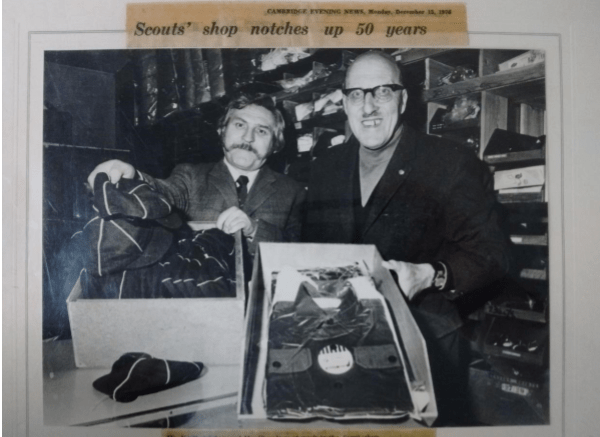
I came upon this framed photograph of John Chambers and Ken North dated December 13th 1976. This is exactly 50 years since the first opening of the Equipment Store, as it was known.

District Badge Secretaries had predated the shop as the source for Scout badges; the earliest reference possibly being 1913 and certainly 1916 when a Miss Laidlaw began her 13 years in this role. Her role overlapped the early days of the shop and in about 1929 S.W. (Waggles) Edwards, first manager of the Equipment Store, took on the role. This later passed to W T Thurbon in 1933 for nine or ten years and then passed to Ken North on his discharge from the Army on grounds of ill health in 1943.

The photograph has been added to the Equipment Store page.

JWR

John Sweet

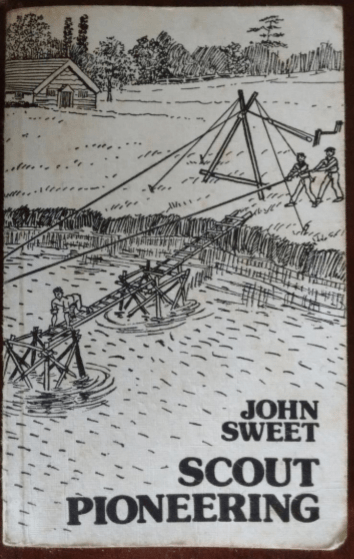
I have re read John Sweet’s ‘Scout Pioneering’ and it is a very practical set of instructions on how to develop pioneering skills within a pack and troop. This appreciation is echoed by Geoffrey Budworth, co founder of the International Guild of Knot tyers, who considers John to be the best writer on scouting knots.

More importantly he thinks about the teaching both in terms of the projects but also how the cubs, scouts and leaders react.

Further he puts pioneering into perspective as a teaching aid, one that was and largely remains the preserve of Scouting.

His merits as a skilled pioneer should warrant his inclusion, where this not a Cambridge District Scout based website. However, the District was fortunate to have John as Field Commissioner for several years (by 1959 – 1969) and invited him to be AGM speaker in both 1965 and 1978. The Abington Spring Bridge is named for the site of its first creation and both Ely and Thorrington are name checked in his work.

JWR

History of the 13th

I have taken a moment to step away from the Evercircular letters and am working through Minutes, Troop reports and camp records from the 13th. These cover many of the years from 1931 – 1951.

Many other records remain in their HQ which I will work through at a later date.

Covering WW2, I can see from a preliminary skim, they have many details that will flesh out existing reports.

The records will be returned to the 13th for safe keeping and, I hope, someone to compile a more complete history than I can commit to at present.

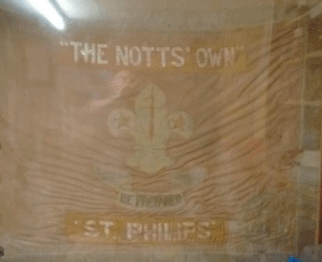
One other item failed to shout its presence from the wall – this flag which is brown, as was their original scarf, and has since faded into this uniform shade. The scarf and the flag were altered about 100 years ago. I struggled to take an adequate photograph in the available light and will try again. The flag was in use in the 1930’s. It may be the original.

JWR