Thomas Gerald Room was a very important member of scouting within Cambridge University and Town. Generally known as Gerald, within Cambridge Scouting he acquired the nickname ‘Ruffingham’ the root of which is unknown. There is no one source detailing his scouting history and work. The following has been compiled from many separate sources, not least the sets of photographs passed to the University Library via Cambridge District Scout Archive by his daughter in 2024.
From his own notes, compiled after the University Rovers became the 31st Cambridge in 1928, he worked with the following troops and groups. My notes in italics.
- 30th S London (Cromwell) 1914 – 1924 Originally 5th Camberwell (Cromwell), renumbered in 1920
- 31st Cambridge 1921 – 1924 31st only after 1928
- 212th Liverpool 1925 – 1926
- 227th Liverpool 1926 – 1928
- 2nd Cambridge 1928 – 1935 Newnham or occasionally St Mark’s
- 30th Cambridge 1929 – 1935 Town Rovers
- 16th Sydney 1935 – Sydney University Crew – leader until 1941
The 200th Liverpool are also mentioned in one set of photographs.
Gerald was born in 1902. His father, Ernest Room, was Chairman of the local Boy Scout Association. Gerald and his younger brother Richard became one of the very earliest Wolf Cubs, possibly ahead of the start in 1914. His older brother L Room was a scout and later Pack Leader. T G Room was to become Troop Leader later Assistant Scout Master (ASM) and his brother G Room (Richard Geoffery Room) took over the Cubs in 1922. From the ‘Log of the Cromwell’s 1931’ we have:
The dates of his birth, entry into scouting and start of Cubs do not quite add up. In 1914 he was 12, scout age. It may be that the ‘Young Scouts’ were well ahead of the national Wolf Cubs and the dates have been ‘fudged’ to obscure the early rule bending or had been simply misremembered. He continued his involvement with the 30th South London after taking up a place at St John’s, Cambridge in 1920 – what would be termed ‘Home work’ in the records of the University Rovers, resigning as ASM in 1924 when he went to Liverpool. In 1930 he was still on the Board of Trustees alongside his father.
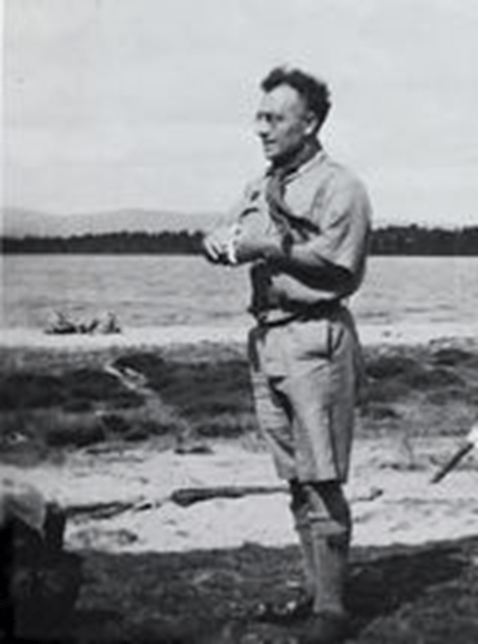
Gatehouse of Fleet 1934
Whilst at St John’s, Cambridge he was one of the founding members of the Cambridge University Rovers in 1920 along with his brother Leslie E Room who was already at Corpus Christi. He was to become Rover Mate of Cuckoo Patrol based at St John’s College.
Along with TM Cherry and J S Ferguson he was one of a trio labelled ‘three faithfuls’’ in a photograph of the Rovers, suggesting a notably active involvement. TM Cherry was a fellow mathematician and like TG Room was to become a Professor of mathematics in Australia. J S Ferguson is lost to Scouting history.
The University Rover entry records that he completed Part II of his wood badge although these notes should not be considered complete and he may have completed more. He attended the Danish World Scout Jamboree in 1924 at the cost of £5. In this year he moved to Liverpool and became involved in the 212th and later 227th Liverpool Troops. These troops and packs were labelled as ‘Settlements’ on the packets of photographs, a term which has been used to describe areas of residential development but here probably refers to the University Settlements, outreach centres that Universities were encouraged to develop in poorer areas in cities. In Liverpool the settlements were based in Park Street, Toxteth and Nile Street which was directly below the east end of Liverpool Cathedral. His photographs from this period show a roof top site within this area of Liverpool but not clearly identifiable as either of these streets. This may have been Harrington Council School in Stanhope Street. The University Settlements were working with the local education authority at Harrington School to provide after care work. The photos also show that the troops were active, camping regularly and displaying good camping skills. The homes of the 212th and 227th have not yet been established. One mention of the 200th also exists. They camped with the 5th but which 5th is unclear. As this camp was in southern England it may have been the 5th Camberwell; although this was renumbered the 30th South London a few years earlier these were personal notes. There is no record of his involvement with the 5th Cambridge, a very large school troop which may have been prepared to support an inner-city troop. The photos do not suggest this; photos of the 5th Cambridge (Perse) at this date show a regimented style not seen here.
In 1928 he returned to Cambridge to take up his fellowship at St John’s and became GSM of the 2nd Cambridge at Newnham, a successful Troop/ Group whose leaders had recently moved on. Only a previous Scout Master, L H Armstrong, remained for a while as Treasurer. Under T G Room’s active and meticulous planning they camped regularly both near Cambridge and into Scotland and Wales. Photographs suggest that the wide range of activities were executed at a high level of competence. A fuller discussion on the photographs can be found below.
During this time from his photographs alone we can work out how very active he was. In 1933 on top of weekly meetings TGR has photographic sets for nineteen camps and weekends activities. In 1934 it was 18. It is not certain every event was photographed but most dates are in the lighter months which would suggest few spare weekends in the better weather.
Within the University he worked under Professor Baker, an early supporter of Scouting in Cambridge. From an academic obituary: ‘The regular ‘tea-party’ held each Saturday afternoon in term time was a distinctive feature of the Baker school. All members were expected to attend and it was a somewhat formal occasion. One distinguished participant recalls of Room that ‘On such occasions most of us were properly dressed, but he often used to rush in, rather later, with shorts revealing bare knees because he, as a Scout-master, had been out with his boys’.
Any involvement with the University Rovers on his return is not clearly documented but his photographs suggest he was involved in the early unemployment camps in 1934 at Abington, south of Cambridge. Some of these camps were coordinated through the University Rovers and intended to give unemployed men the opportunity to demonstrate that they could work within a disciplined environment. In 1928 he became involved with the District Rovers, 30th Cambridge and he held the District role as ADC Rovers from c. 1930 to 1935. The 30th Cambridge and the 2nd were often involved in work at the new County campsite at Abington (1932 onward), and had camped at the previous campsite at Upend, from which the Abington hut was transferred. The Crew (30th Rovers), which took its members from town groups diminished after his move to Australia and were effectively defunct by 1938.
In 1932 he became a formal member of Abington Camp site support team. ‘Committee of Management: A committee of Management for the camping site was elected, as follows: Messer’s, T G Room, C T Wood, R P Richards & E H Lewis.’ He took photographs of work at Abington with the 2nd and the 30th on many occasions and was probably the most directly involved of the committee of management in the physical work on the site.
In 1933 he joined the Cruise of the Calgaric along with his sister, listed as
- Miss M. A. Room Ex.-Tawny Owl, London, S.E.
- Mr. T. G. Room Asst. Dist. Comm., Cambridgeshire.
The “Peace Cruise” of SS Calgaric sailed to the Baltic in August 1933. On board were the Founder of the Scout & Guide Movements, the Chief Scout, Lord Baden-Powell and his wife, the Chief Guide. The party consisted of 100 Scouters (including lady Cubmasters); 475 Guiders; and 80 non-Scouts or Guides.
Ruffingham was recalled as the ‘originator’ of the Grafton Street Gazette and Abington Advertiser, a District periodical. The first known issue under this name was in 1934. It had, however, had previous names and started in 1922. His first engagement in this is unclear, but on a brief return to Cambridge in 1948 the title reverted to GG & AA in his honour. This newsletter was very important in what was a very large and widespread District.
In 1935 he took up the post of Professor of Mathematics in Sydney, Australia. He became leader of the Sydney University Rover Crew, a role he relinquished in 1941.
In January 1940 a small unofficial group at the University of Sydney was established under Thomas Gerald Room. Assisted by Mr. Richard Jenkins Lyons they studied Japanese codes. They handled many coded messages supplied to them by the Censorship Staff. Needing to learn Japanese quickly they did so in around eight months and Gerald credited Margaret Lake. Later the group expanded and moved Melbourne and later to Brisbane. T G Room remained a civilian but ran ‘Hut 9’ and the team throughout the war. (ozatwar.com) This work was seen as part of the work centred on Bletchley Park and at the end of the war Professor Room was advising his University on the merits of the machines that were the first computers.
T M Cherry, who had become Professor of Mathematics in Melbourne was to remain a friend, visiting for meals with T G Rooms family. His wartime work may have some small overlap with Professor Rooms decipherment but as with all those engaged in this work was sworn to long term secrecy and Professor Room did not talk about it to his family. Geraldine Maini (nee Room), Gerald’s daughter, only came to know about it when, attending a university lecture, she was asked if she was related to the Room who deciphered the Japanese codes. The work was initially centred on weather codes, which underplays the importance of this information which directly informed the likelihood of attack.
From an academic obituary we have a clear notion of his Scouting. This is in stark contrast to that of a near contemporary Professor Patrick Duff in Cambridge whose Scouting life did not impinge on his academic identity and has no mention in his obituaries.
During all this time in Cambridge (and for some years afterwards in Sydney), Room continued to be very active in the Rover Scouts. He loved hiking and being in the open air, and delighted in exploring the countryside. These activities provided him, too, with complete relaxation from the hours of concentrated thought on mathematics. But Scouting meant much more than this to him: it demanded leadership, organization and a willingness to help others. This side of Scouting he took very seriously. Notebooks of his are extant in which instructions for his Troop are set forth with careful diagrams and in minute detail.
T G Room died in 1986.
J W R Archivist Jan 2025
 Cambridge District Scout Archive