Cambridge District Scout Archive
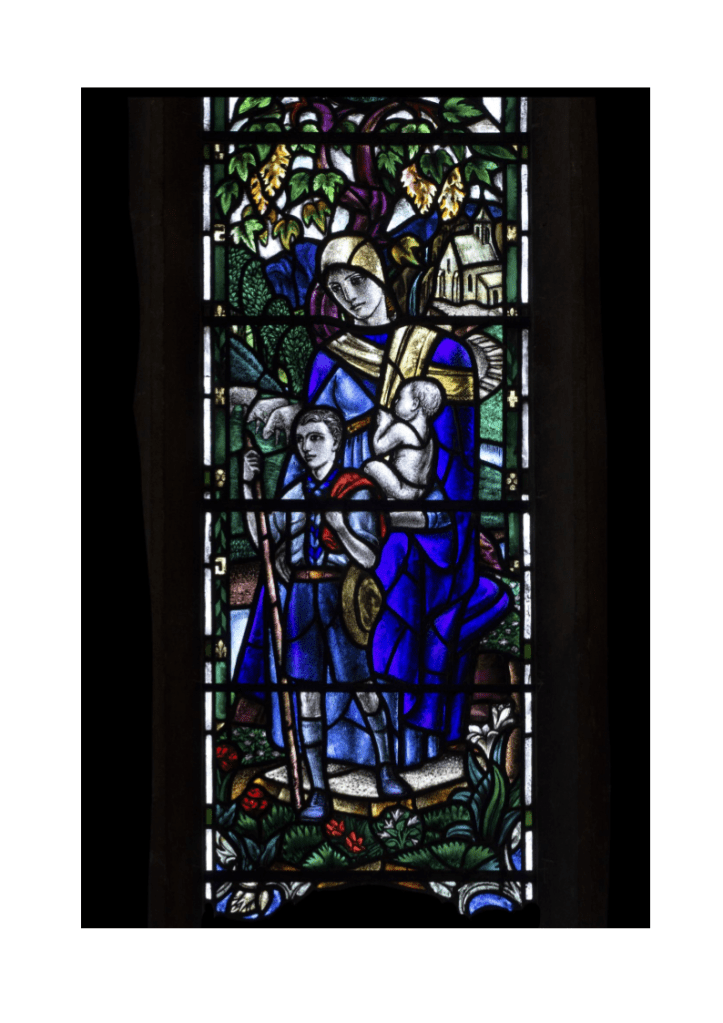
Detail of ‘Womanhood’, at All Saints Church, Cambridge. Photo by Adrian Powter
The Womanhood window at All Saints Church on Jesus Lane, Cambridge is a work by Douglas Strachan from 1944. It is the gift of John Murrish, founding Scoutmaster of the 12th Cambridge whose scarf is reproduced in the glass in its 1943 form.
The central panel shows the Virgin and the Child as a mother with a baby, standing behind a young boy dressed as a Scout; he’s just taking his first step into the wider world.
This detail is flanked by women caring for strangers and for the sick, and by four portraits of famous women of compassion, charity, and bravery: Elizabeth Fry, Josephine Butler, Cecile Isherwood, and Edith Cavell.
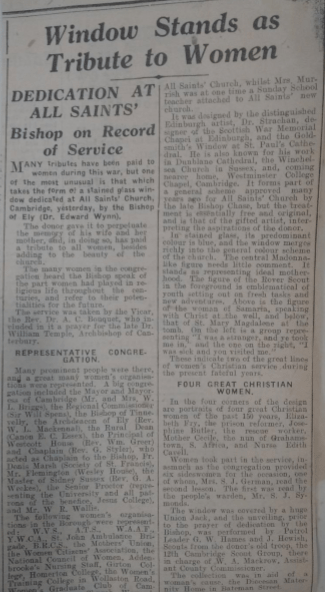
A fuller description is available from http://www.westminster.cam.ac.uk from where this photograph has been reproduced.
Many other instances of stained glass incorporating Scout pictures or symbols are known including several of Carlos’ The Pathfinder. One other instance of a Scout leader in Cambridge funding stained glass is known; MacFarlane Grieve at Magdalene College. This does not have a Scout element. See under Individuals.
JWR Archivist Apr 2019
The following from Adrian Powter, written in 24th March 2020 during the social isolation in the first months of Covid 19, gives further information
Dear
… but it will be open again and is a really impressive memorial.
The window is dedicated to John’s wife, Kate Louisa who died in 1942 and her mother, Elizabeth Brown who lived at 36 Jesus Lane and died in 1915, the same year as Edith Cavell. It was the last alteration to the church before it was made redundant in 1973. As you rightly say, it was given a faculty by the Diocese of Ely and installed in 1944 at a very dark time in world history and its colour and positivity and message must surely have been an inspiration for the dwindling congregation at the church.
The first mention I know of was in the All Saints Parish magazine of October 1943. By that point, a design had been submitted by Douglas Strachan and the Bishop’s Advisory Committee met to vote upon it on October 19th. This included Lord Sandwich, a member of the Fine Arts Commitee of HM Government and Professor Richardson of St Catharine’s College. John’s description of the window, submitted to this panel stated the following with regard to the central panel:
“In the central panel is blue-robed figure seated, with a child in her arms. She stands as the symbol of womanhood and motherhood, with a special remembrance of the blessed Mother of Christ, who said “Behold the handmaid of the Lord; be it unto me according to Thy word,” and so expressed for all time the idea of human co-operation with and surrender to the Divine Purpose. Behind this figure rises the Tree of Life, reminiscent of Eden, and in the landscape, built upon a rock, stands a little village church, with all that it recalls. Winding through the landscape is the River of Water of Life. Thus Genesis and Revelation are linked together. In front of the figure of womanhood stands a young pilgrim with staff in hand, setting out on life’s journey from his mother’s knee, and treading already upon the thorns and flowers of the earthly road. It is expected that he will be garbed as a Rover Scout, wearing the scarf of Mr Murrish’s old troop – one of the very first to be formed in the town.”
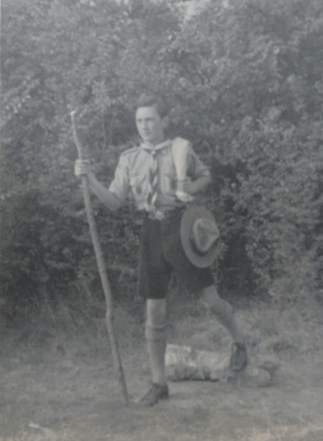
In the finished window the scout doesn’t appear to be on her knee (as far as I can make out anyway!) so perhaps the photograph provided by Murrish of his model scout lent itself to a more perpendicular rendering. The best thing is that we know the scout’s name – William Hames, known as Bill. He was probably in adolescence at the time, perhaps 12 or 13 years old? You would know the specifics of which stage of Scout-hood he was in but the photo lends itself to a boy of that sort of age and you may well have a record of his attendance in your archives. The depiction of his image in glass is nearly identical to the photograph which pleases me greatly. Bill lived a good life and most of it was in the nearby village of Fulbourn after a career in the navy. His cousin is still alive and lives in Cherry Hinton and is active in their history society.
John himself was originally from St Just, Cornwall and he spent his youth in Penzance (according to a small obituary cutting). He died on September 3rd 1966 in Northampton aged 77. What is remarkable was that he left an enormous sum to All Saints’ Church in his will – £35,701 gross (with duty of £7,679) so he clearly loved it a great deal and, of course, he left a stunning work of art there 22 years earlier.
Kind regards,
Adrian Powter
Bill Hames was remembered by the 12th, his marriage in 1952 to Mary Longley being noted in the Troop magazine ‘The Link’.
William George Ellis Philips, SM 1st Cambridge (Sea Scouts) is commemorated by a stained glass window at Castle Barnard where his brother “Sammy” was Head of Art. William George Ellis Phillips is not known to be either a pupil or member of staff Barnard Castle School. He is described as a schoolmaster and is included on the Cambridge Press RoH where he was also employed as a Reader of classics. His brother was Samuel Ellis Phillips – the Art Master at the school for over thirty years. William died in Germany as a prisoner of war – he was serving in the Benbow Battalion – which was formed from Royal Navy personnel who didn’t have a ship to serve in. Sammy must have used his clout to remember his younger bother in this way – the chapel of course was less than ten years old at this time, and Sammy was widely recognised as the protege of Edward Dalrymple Walrond, the prime mover and shaker in its building.
JWR Archivist Apr 2019
 Cambridge District Scout Archive