Cambridge District Scout Archive
Proposed in 1942 and started during the last years of the Second World War the International Relief Service comprised teams trained to offer support across countries affected by war. Seventy one men and twenty six women are recorded on the Scout teams. We know of four Cambridge members in the Scout and Guide teams, two born in Cambridge, two from Magdalene College. Their names and SIRS history is given below.
The initiative was initially reported under several names, Relief Abroad Service, Scout Relief Abroad Service and later as (Scout) International Relief Service. The Job Day of May 20th 1944 was intended to raise £20,000 at a shilling a boy to fund this service. By October 1944 The Forces Bulletin was reporting that £29,000 had been raised. They eventually raised £32000 which was doubled by the Government. The same Bulletin announced the first Service Team was in operation (now on active service) in April 1944. By October five teams were in service in the Middle East and NW Europe.

The International Relief Service was staffed by many organisations, the Guides, Red Cross, Quakers, Jewish Relief, Salvation Army , Save the Children, Friends, St John’s, unnamed Catholic organisations, etc. They were collectively the Council of British Societies for Relief Abroad (COBSRA) and the Scouts worked as part of the British Red Cross section. Twenty two (numbers vary) societies joined this Council. The service was replaced by the United Nations Relief and Rehabilitation Administration (UNRRA) in 1946. Seventy one men (elsewhere 67) and twenty six women Scouters took time off work to join the Scout teams. The teams had largely disbanded by September 1946.
Scout sections worked in Greece, Italy, Yugoslavia, Egypt, Palestine, and Syria. Four Scout Units, numbered from 100, worked in NW Europe (France, Belgium, Germany). They were split into groups No’s 3, 102, 106, 122 working in refugee camps and hospitals. (The early numbering 3 and elsewhere 2 are an unclear and possibly Scout based system.) One team, 102, worked at Belsen. Later five members were sent to Hong Kong (no known number) and one pair worked in Albania providing water purification works. Some members worked with the Guides in No. 2 Hospital Section. The Guides were 107 and probably others, and 109 was the International Voluntary Service for Peace.
The volunteers were not part of the military hierarchy but were later given rank as it was found necessary when working with the army. All members were Lieutenant, Team leaders were Captains, and overall manager was a Lt Colonel. Of the first twelve abroad in France in September 1944 five were over age for military service, three had been invalided out, four were graded C-3 and unfit for service.
Cambridge Archive
13/5/1944 A letter from Rover Scout Arthur on HMS Duke (shore establishment for training) to the 13th Cambridge troop drew attention to the front page of the Scouter of April and the Scout Relief Abroad Fund. Prior to enlistment he had spent some time at Roland House with three Rover Scouts who were the first to go abroad on this service. Being inquisitive he learnt some ‘horrible things that are not fit for you to hear and I hope that you never will.’ He urged the 13th to work hard for the fund. A single entry elsewhere notes 6d. Gardening, 9d. odd jobs.
1944 7th Cambridge all worked to raised money for the Boy Scout Relied Abroad Fund aiming to make 1/- a boy and reaching double that at £6 in total.
18/6/1945 SM R H Ellwood (1st Cambridge) working for six months with Scout Relief Team Overseas District Minutes R Ellwood was listed as GSM 1st Cambridge in ‘Post 32’ list and ACM 12th around 1945.
1946 AGM Reported as working in Germany
Mr F P Ellwood (SM 12th Cambridge) spoke on SIRS at the AGM, Ron’s brother.
The following is quoted in full from the 60th Rover Crew (Leys school) record. The meeting following the return of the school to Cambridge after five years in Pitlochry, Scotland and of various Crew members from the War.
From 60th Cambridge (Leys) Rover Crew report in the Leys Fortnightly late 1946 ‘The first month of this term was devoted to cleaning and redecorating the Den for a second reunion at which 21 Rovers listened to the story of the Scout Relief teams, told by Mr. Ellwood, one of the members. His yarn included the description of a Polish Nativity play in which Hitler and Goering replaced Herod and Pilate.’
Cambridge participants
1 Ron H Ellwood worked in NW Europe with Section 102. From the dates he was a replacement member of the team. He was listed as living at 101 Windsor St Cambridge after his return but did not appear to be active in the reunion newsletters but did participate in the reunion dinners of 1947, 1948 and 1949. He was a tool maker and hence in a reserved occupation, a designation that meant he was either exempt from conscription or prohibited from joining the Armed Forces.

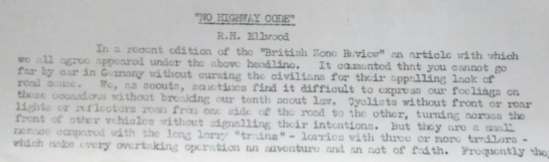
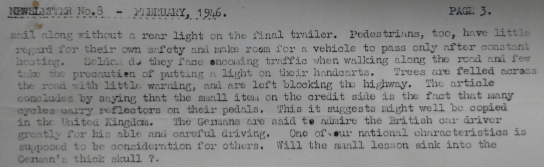
He wrote the following piece whilst on service Feb 1946 Sec 106 Newsletter No. 8

Unnamed SIRS team. The Scout badge can be seen on the battledress and they wore a green Rover strap. Whilst not members of the Armed Forces they were given ranks to enable them to operate within the hierarchy of the Army.
Other Cambridge Links
2 Frederick David Lenton, (known as David) who was born 1926, a scout at Oundle school (see photograph below) where he lost a finger in a shooting range incident and then a student at Magdalene College Cambridge from 1942 – 1945. He is next known as teaching at Sedbergh school before starting a Dip Ed in 1947, but the dates are unclear. As a replacement member of the SIRS teams the dates work. He went on to become a teacher of classics and Scout Master at Portsmouth Grammar School before leaving to study as a catholic priest, something he did not complete, and returned to teach at Queen Elizabeth school, Wakefield and finally Ampleforth. He is specifically named in a University Crew COH Minute book as a replacement and ‘another Magdalene man is to follow’. The career of the replacement members of SIRS is less well documented. The Magdalene archivist has provided some correspondence in which his tutor describes him as a friend and ex pupil, and as ‘exceptionally industrious and reasonably intelligent but not at all brilliant‘ with an ‘excellent character and high ideals, his chief interest being in Boy scouting for which he evidently has a real genius‘.

3 John Murray Irvine (known as Murray or ‘Munk’) was the other replacement who joined after David Lenton. He had Polio as a child. He was educated at Charterhouse where his father, a classicist, was a teacher, and Magdalene College Cambridge. The College archivist confirms his engagement with Scouts and SIRS and The Times obituary of 2005 reports that he worked for a year with displaced people in 1946 before starting training for ordination at Ely Theological College. He went on to be Chaplin at Sidney Sussex, Chancellor and Librarian at Hereford Cathedral and Provost of Southwell Minster. Rev G K Tibbatts wrote on his behalf supporting his application, as did his tutor, corresponding with H R S Thomas, secretary to SIRS. He planned to return temporarily from his work in Germany to take his Degree around June 7th 1946.
4 Alison Duke, Cambridge born classicist at Girls Perse and Girton, later one of the first batch of Vice Presidents of CUSAGC, lead the Guides International Relief Service team in Greece 1944- 1946.
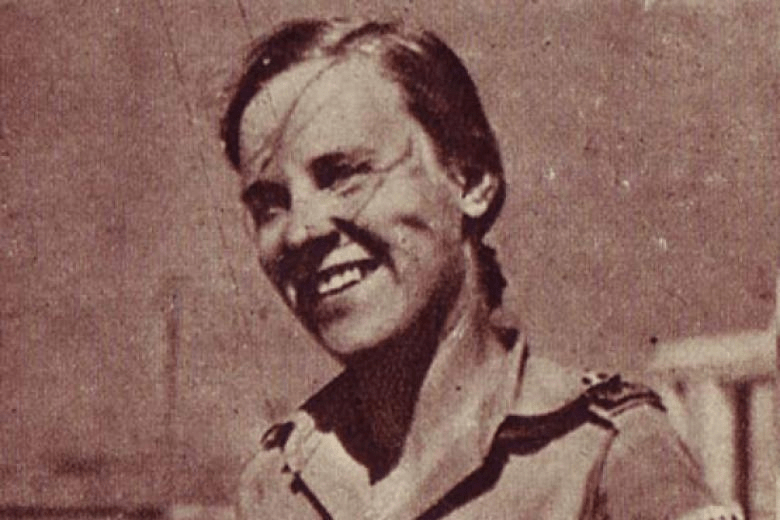
5 Marjory Jarman, a Guide from 1916, was a member of the Guide International Service (GIS) alongside Alison Duke, with whom she volunteered in Cairo, Egypt and Greece after WWII. Known as the mother of Cambridgeshire Guiding.
See also
- The Least of These John R Monnet (Jean Rodolph Monnet)
- Life is a Mountain Miss Olive Buckman
- Scout Relief work in NW Europe | Wartime – Second World War (WWII) | Harpenden History (harpenden-history.org.uk)
- World scouting BSA 1947
- The Left Handshake Hilary St George p 106 +
- http://www.worldscoutingmuseum.org/files/GIS-SIRS.pdf
- https://www.crichparish.co.uk/PDF/GIS-SIRS.pdf
A Partial list of members is available.
JWR Archivist Sept 2019
 Cambridge District Scout Archive